

EXPLORATION & PRODUCTION (E&P) DATABANK
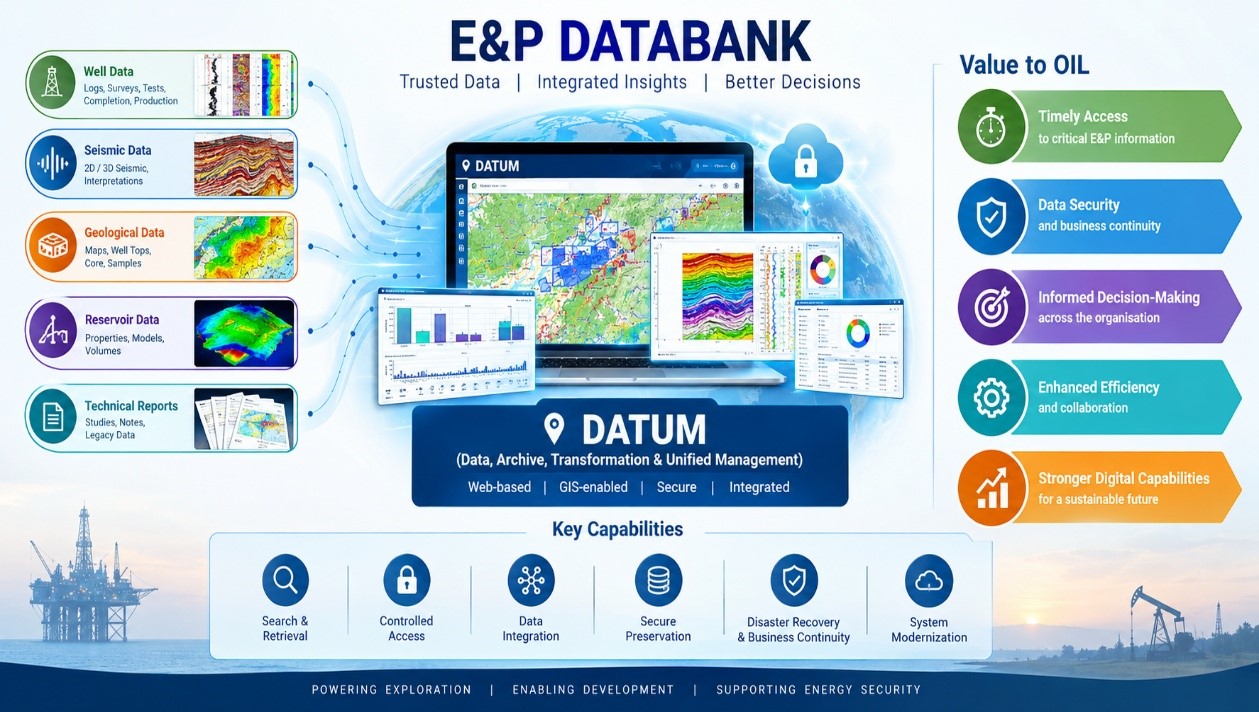
The E&P Databank (E&P DB) of Geology & Reservoir Department serves as OIL’s centralized system for the management, quality assurance, preservation, integration and secure dissemination of E&P data. It provides organized and timely access to critical geological, geophysical, well, reservoir and associated technical data, including valuable legacy information, to support exploration, development, reservoir studies and informed technical decision-making across the organization.
The E&P Databank team administers and maintains “DATUM” (Data, Archive, Transformation & Unified Management), a web-based, GIS-enabled E&P data management platform supported by a Disaster Recovery Centre (DRC). DATUM replaced the erstwhile R5000 suite and provides an integrated environment for efficient data search, retrieval, visualization, management and dissemination, with enhanced security, accessibility and business continuity.
Key Capabilities
- Centralized Data Management: Organized management of diverse E&P datasets and technical information.
- Search & Retrieval: Browser and URL based access to relevant E&P data for efficient technical workflows.
- Data Quality & Integrity: Quality assurance, validation and preservation of critical datasets.
- Secure Access: Permission-based access to ensure data security, confidentiality and appropriate utilization.
- Data Integration: Integration with relevant enterprise and technical systems, including GRPC and ERP-SAP, for seamless information flow.
- Legacy Data Digitization & Preservation: Digitization and preservation of valuable historical and legacy E&P records.
- GIS-Enabled Visualization: Spatial visualization and integration of E&P information to support interpretation and decision-making.
- Disaster Recovery & Business Continuity: DRC-enabled backup, redundancy and protection of critical E&P data and services.
- Continuous Modernization: Progressive enhancement of platform capabilities and data-management practices
The E&P Databank provides a reliable, integrated and quality assured digital environment for OIL’s E&P information assets. Through systematic data management, digitization, legacy-data preservation, integration and secure accessibility, it enhances the usability and value of the Company’s E&P data, supports multidisciplinary technical workflows and strengthens OIL’s digital capabilities for exploration, development and reservoir management.
PETROPHYSICS
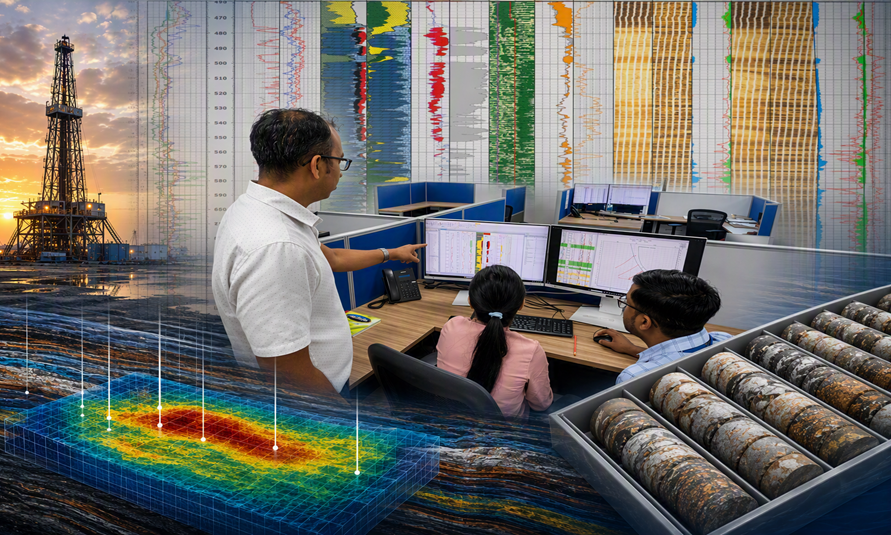
The Petrophysics Group of the Geology & Reservoir (G&R) Department is responsible for formation evaluation, petrophysical characterization and reservoir quality assessment of wells across OIL's diverse exploration, development and producing portfolio. These includes the petroleum exploration & mining areas of the Assam Shelf & Assam-Arakan Fold Belt, Rajasthan Field, and other domestic NELP/OALP/DSF Blocks spread across onshore and offshore areas of India, along with domestic JV Blocks and international assets. The Group integrates well-logs, core, mud-logging, pressure, well-test and production data to characterize lithology, porosity, permeability, fluid saturation, net pay and hydrocarbon pore volume, with available core, test and production data used for calibration to reduce uncertainty in subsurface evaluation and volumetric estimation.
Key Activities and Responsibilities:
- New Well Evaluation: Interprets well-logs to identify and characterize the prospective intervals, and support testing, completion and development decisions.
- Logging Programme & Data Quality: Provides technical inputs for planning and acquisition of well-log data, data quality control and validation.
- Advanced Formation Evaluation: Application of advanced technologies and workflows, including NMR, borehole imaging and specialized logging techniques for complex, challenging and unconventional reservoirs.
- Legacy Well Re-evaluation: Re-evaluation of old wells to identify bypassed pay, additional reservoir potential and workover opportunities.
- Exploration & Development Support: Provides petrophysical inputs for prospect evaluation, static/dynamic modelling, well placement and field development planning.
- Reserves & Resources Support: Provides petrophysical inputs for in-place volume estimation, reserves and resource assessment, including uncertainty assessment.
- Mature Field & Abandonment Evaluation: Assesses the remaining hydrocarbon potential in mature and candidate abandonment wells to support informed decisions on workover, reactivation or abandonment.
- Technology, Workflow & Capability Development: Promotes the adoption of advanced technologies, software, standardized workflows and integrated interpretation practices, along with continuous development of technical competencies.
- Technical Assurance & Consultancy Review: Provides technical review and quality assurance of petrophysical interpretations and workflows of consultancy studies to ensure technical robustness and effective utilization of subsurface data.
The Petrophysics Group serves as a key technical interface across multiple sub-surface disciplines, translating formation-evaluation and reservoir-characterization insights into reliable inputs for informed exploration, development and reservoir-management decisions.
FIELD DEVELOPMENT CENTRE (FDC)
The Field Development Centre (FDC) of the Geology & Reservoir (G&R) Department comprises a multidisciplinary team of experienced Geologists and Geophysicists dedicated to supporting the field development activities of Oil India Limited (OIL). The Centre undertakes integrated subsurface studies for the Main Producing Areas (MPAs) of Assam and Arunachal Pradesh, with the objective of optimizing field development, enhancing hydrocarbon recovery, and sustaining the Company's oil and gas production.
The Field Development Centre (FDC) plays a strategic role in advancing OIL’s field development activities by providing integrated, technically robust subsurface inputs for effective Field Development Plans. Through systematic reservoir evaluation, identification of undrained and underdeveloped hydrocarbon potential, maturation of development opportunities, and generation of viable drilling locations. By translating subsurface opportunities into actionable development proposals and drilling locations, the Centre serves as a critical link between reservoir understanding and field execution, contributing to accelerated field development, maximization of the existing asset base, and OIL’s broader objective of enhancing domestic hydrocarbon production.
Key Capabilities
- Geological and Geophysical Evaluation: Integration of geological, geophysical, petrophysical and reservoir engineering inputs for comprehensive reservoir evaluation.
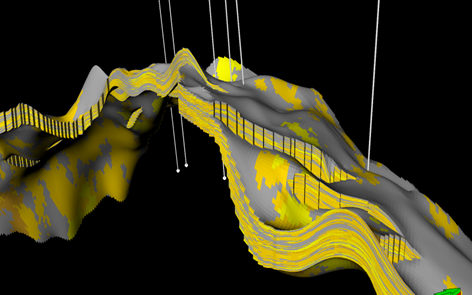
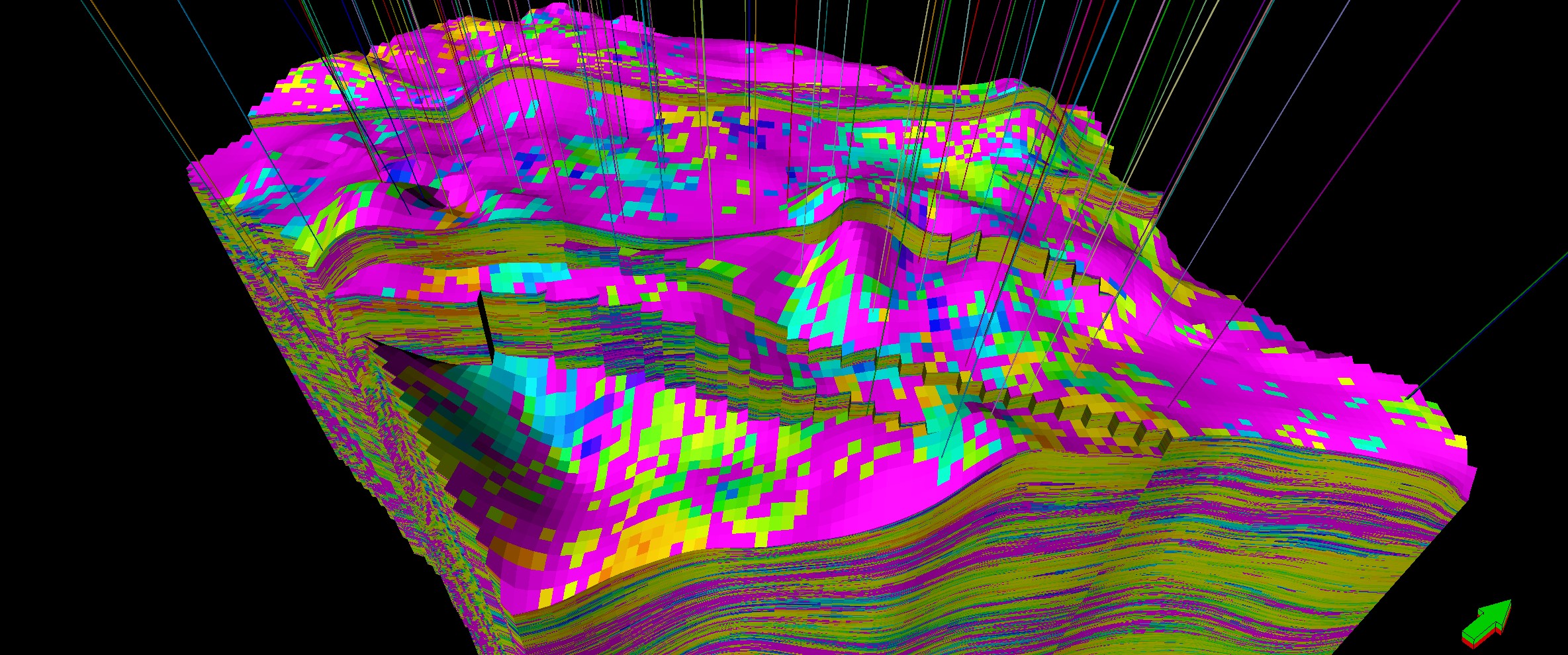
- Static Reservoir Modelling: Construction, updating and QC of 3D static reservoir models.
- Reservoir Potential Assessment: Identification and evaluation of undrained, underdeveloped and bypassed hydrocarbon potential.
- Drilling Location Generation: Identification and justification of new development and infill drilling locations.
- Field Development Planning: Preparation of integrated FDPs and development strategies for optimized reservoir recovery. Collaboration with multidisciplinary teams to translate subsurface understanding into actionable field-development plans.

DRILLING OPERATIONS & WELL PLANNING
Monitoring of drilling operations for exploratory and development wells is supported by comprehensive pre-spud planning, well design, and drilling plan preparation undertaken by a dedicated team of enthusiastic geologists. The team's activities encompass geological interpretation, acquisition and interpretation of high-quality mud logging data, detailed drill cutting sample analysis using advanced stereo zoom microscopy, and core description and interpretation to enhance subsurface understanding. Through continuous geological surveillance and integrated data evaluation, critical inputs are provided for informed decision-making during drilling operations, including perforation strategy and reservoir assessment. Committed to geological excellence, the team adopts innovative techniques and advanced methodologies to maximize the exploration and development potential of various proliferous basin. Continuous evaluation and refinement of existing practices, coupled with the preparation of tentative and detailed drilling plans, contribute to safer operations, improved drilling efficiency, reduced geological uncertainty, and value-driven exploration and field development outcomes
Key Capabilities
- Comprehensive pre-spud geological planning and well design support for exploratory and development drilling operations.
- Preparation of tentative and detailed drilling plans to optimize drilling performance and well objectives.
- Real-time geological monitoring and surveillance during drilling operations.
- Acquisition, quality control, and interpretation of high-quality mud logging data.
- Detailed drill cutting analysis using advanced microscopy for accurate lithological evaluation.
- Core description, sedimentological interpretation, and reservoir characterization.
- Integrated geological data evaluation to reduce subsurface uncertainty and improve decision-making.
- Continuous wellsite support through formation correlation and stratigraphic interpretation.
Through integrated well planning, geological surveillance, and drilling operations support, the team delivers reliable subsurface insights that enhance decision-making, reduce geological uncertainty, and optimize exploration and development outcomes. Looking ahead, continued adoption of advanced technologies, innovative workflows, and data-driven approaches will further strengthen drilling success, reservoir understanding, and sustainable hydrocarbon resource development.
RESERVOIR MANAGEMENT & MONITORING CENTRE (RM2C)
Reservoir Engineering plays a pivotal role throughout the entire life cycle of a hydrocarbon reservoir—from the first production of hydrocarbons at the surface through field development and production optimization to ultimate field abandonment. Effective reservoir monitoring and management are essential for maximizing hydrocarbon recovery, optimizing production and ensuring efficient reservoir performance, particularly in brown and mature fields. Reservoir management is equally important for newly discovered fields, as early implementation of sound reservoir surveillance and management practices provides a strong foundation for maximizing the long-term recovery potential of the reservoir.
The Reservoir Management & Monitoring Centre (RM2C) comprises a team of experienced Reservoir Engineers organized into two acreage-based teams—Western and Eastern Field Groups—along with a dedicated team responsible for Bottom Hole Pressure (BHP) monitoring and reservoir database management. The Centre undertakes a wide range of reservoir engineering, surveillance, modelling and performance-monitoring activities to support informed and effective field-development and production decisions.
Key Capabilities
- Preparation of Field Development Plan in coordination with Development Team: Post discovery of oil & gas field, preparation of Field Development Plan with identification of appraisal locations to delineate the oil & gas field and identification of optimum number of development locations to maximise oil & gas recovery while ensuring profitability.
- Generation of Long-Term Oil & Gas Production Profile: Generation of long-term oil & gas production profile of the company based on the established oil & gas reserves of the discovered oil & gas field, which serves as key input for company’s future revenue, financial valuation, and strategic life cycle.
- Reservoir Simulation Studies: Development and application of dynamic reservoir simulation models to understand and predict the movement of fluids—including oil, gas and water—within the reservoir. Multiple development and production scenarios are evaluated in a virtual environment to identify technically and economically optimum strategies for field development, production enhancement and recovery maximization.
- Classical Reservoir Engineering Studies: Comprehensive reservoir evaluation and surveillance studies encompassing well testing, reservoir pressure monitoring, PVT analysis of reservoir fluid samples, material balance studies, decline curve analysis and other diagnostic techniques for assessing reservoir behaviour and performance.
- Reservoir Database Management: Systematic compilation, validation, updating and maintenance of reservoir, pressure-production and chemical data in the Company's indigenously developed GRPC (Geological, Reservoir, Production & Chemical) database system. The database serves as an important repository for reservoir surveillance, performance analysis and decision-making.
- Well Test and BHP Monitoring: Designs, coordinates and monitors periodic Bottom Hole Pressure (BHP) surveys and well testing programmes for effective reservoir surveillance. Detailed interpretation of well test data is carried out to evaluate reservoir characteristics, pressure behaviour, permeability, skin factor, reservoir boundaries and well productivity. The generated inputs support reservoir management, production optimization, reserve estimation, well intervention planning and field development activities.
- EOR/IOR and Water-Flood Management: Monitoring and evaluation of Enhanced Oil Recovery (EOR) and Improved Oil Recovery (IOR) initiatives, with particular emphasis on water-injection operations. Regular reservoir surveillance and performance studies are carried out to assess injection effectiveness, optimize water-flood performance and identify opportunities for improved sweep efficiency and incremental hydrocarbon recovery.
Through integrated reservoir surveillance, engineering analysis, simulation and data-driven monitoring, RM2C contributes to optimizing reservoir performance, extending the productive life of fields and maximizing hydrocarbon recovery from both mature and newly developed assets.
RESERVES APPRAISAL SECTION
Reserves appraisal is a critical oil and gas function, foundational for evaluating exploration and production performance, planning activities, and supporting strategic decisions. The Reserves Appraisal Team of Geologists and Reservoir Engineers coordinates with operational teams to perform integrated evaluations of hydrocarbon reserves. They periodically assess and update volumes under regulatory guidelines and industry best practices.
These evaluated reserves and resources are reported to statutory authorities at prescribed intervals. Additionally, comprehensive assessments are conducted at each financial year-end to establish the Company's overall reserves position. This process integrates geological, reservoir engineering, production, and operational data to robustly assess hydrocarbon volumes and commercial potential. Ultimately, these results provide key inputs for field development planning, portfolio management, and long-term corporate strategy.
Functions of Reserves Appraisal Section
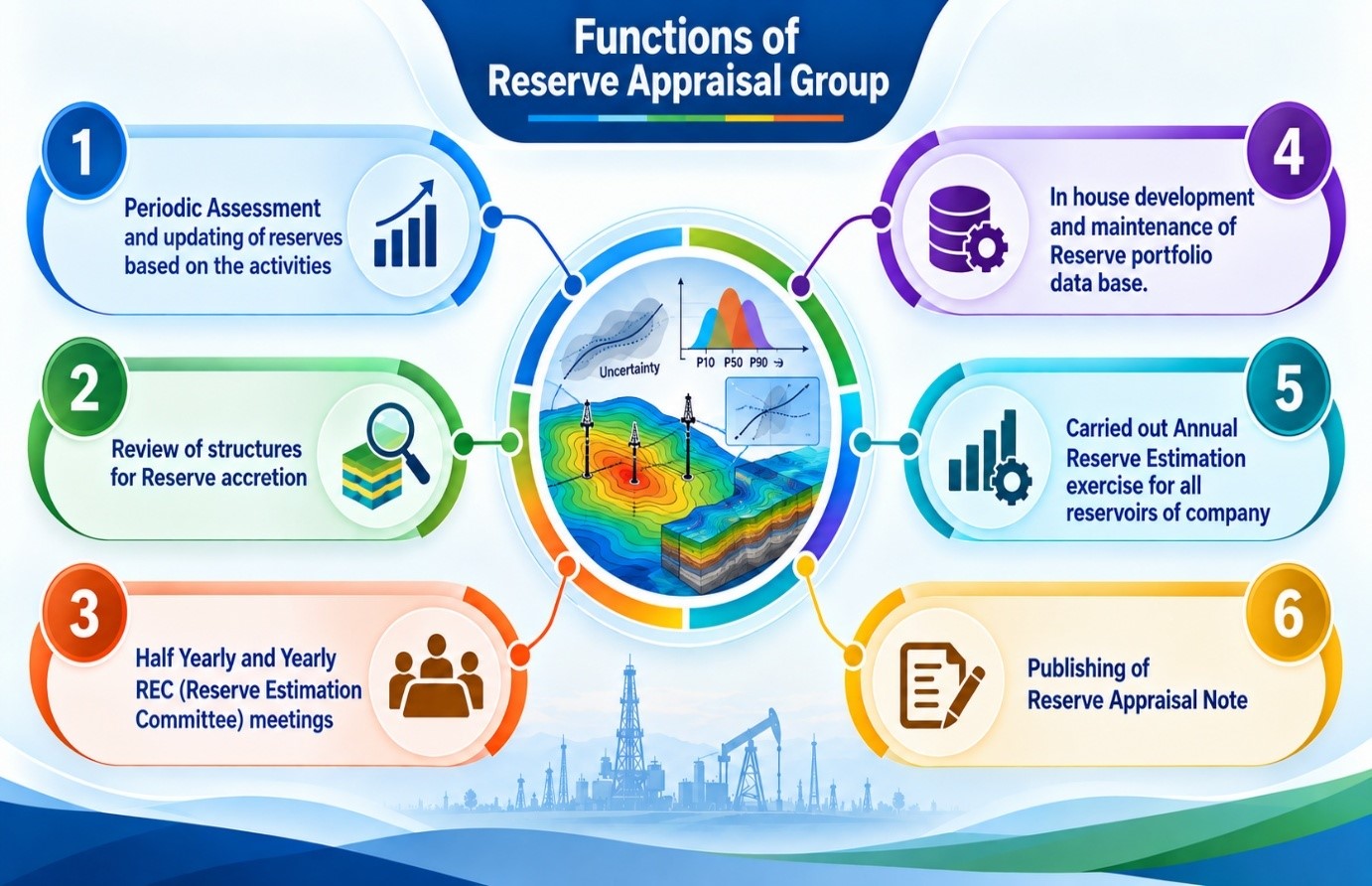
- Periodic assessment and updating of resource/reserves based on the activities.
- Review of the identified structures based on parameters, maps, correlations and pressure-production data.
- Conducting half-yearly and yearly REC (Reserve Estimation Committee) meetings.
- In-house development and maintenance of the Reserve Portfolio Database.
- Carrying out annual Reserve Estimation exercises for all reservoirs of the company.
- Publishing of Reserve Appraisal Notes.
SCORELSCORELSCORELSCORELSCOREL
The Sedimentological and Core Laboratory is involved in the analysis and interpretation of core and sedimentological data to support geological and reservoir characterization studies. The laboratory undertakes detailed physical description of cores and analysis of various sedimentological parameters, sedimentary structures, and facies characteristics.
The integrated interpretation of these datasets facilitates the understanding of depositional environments, sediment provenance, reservoir characteristics, and sand-body geometry. The laboratory also provides routine sedimentological studies and technical support to other Spheres, Departments and Assets.
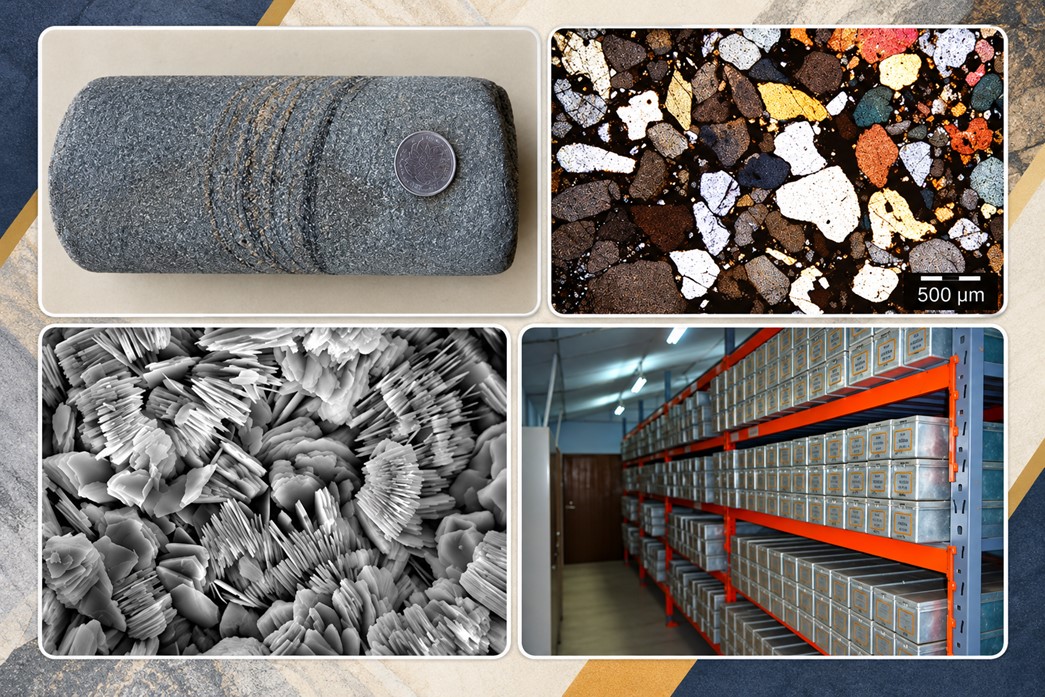
- Laboratory Studies: Sedimentological analysis of reservoir parameters.
- Macroscopic Analysis: Physical description of core samples and textural analysis.
- Microscopic Analysis: Thin-section petrography, XRD and SEM analysis.
- Characterization of different facies, inference of depositional environments and determination of sand body geometry.
- Generation of sedimentological study reports.
- Supporting other spheres/departments/assets in routine sedimentological studies and preparation of samples for research studies.
- Preservation & Storage: Preservation and storage of all drill-cutting, sidewall core and conventional core samples from FHQ and other spheres.


